Louis XIV didn't build Versailles out of artistic vision. He built it out of jealousy — and then turned it into a political trap. When his finance minister Nicolas Fouquet completed Vaux-le-Vicomte in 1661, Louis had him arrested and essentially confiscated his architect, his landscape designer, and his decorators. Everything Fouquet built, Louis built bigger. The result was a palace that housed 20,000 people by 1682, including 6,000 nobles kept there deliberately idle — close enough to court to need the king's favor for everything, too busy with ceremony to plot against him. It's one of the most calculated power moves in the history of architecture.
Explore Versailles
Discover Versailles through photos that tell the story.
Find out how well you know Versailles.
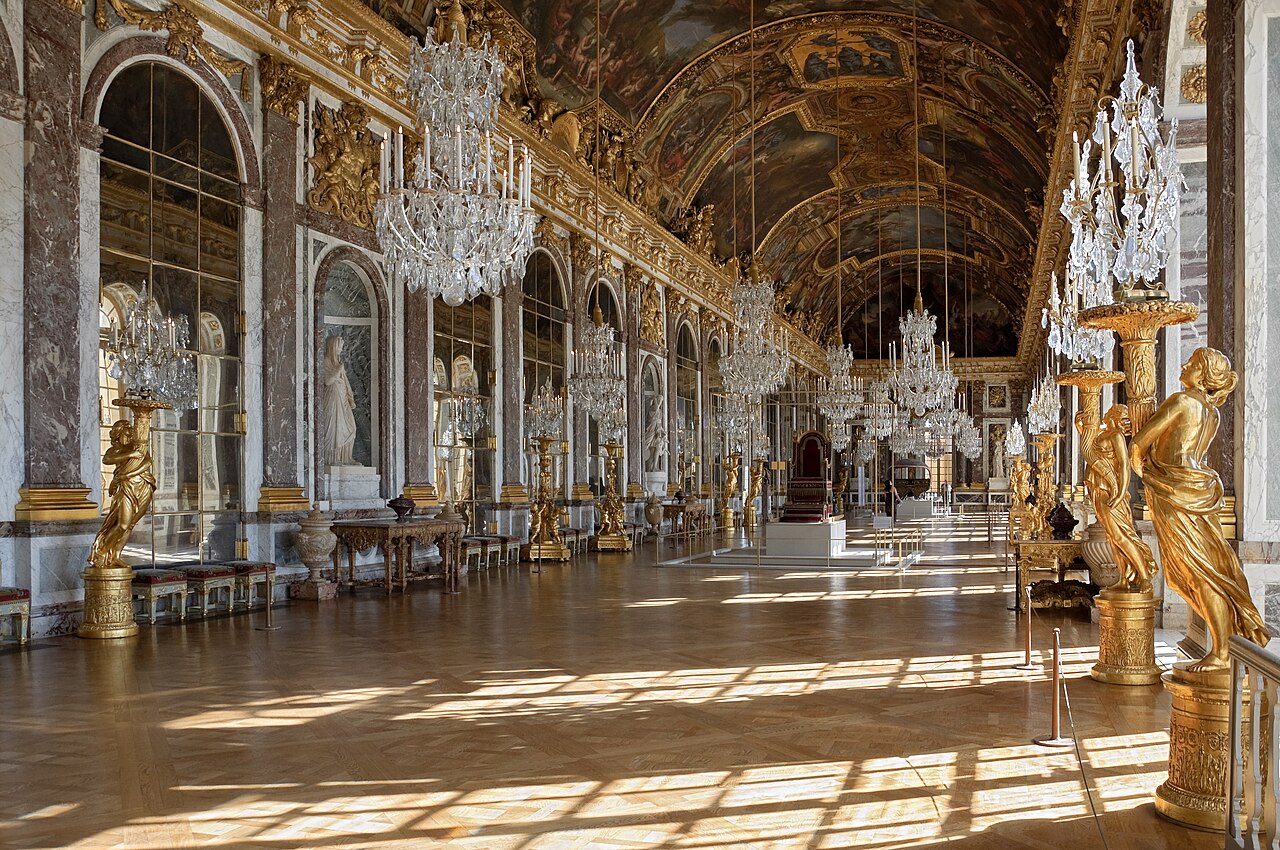
The Hall of Mirrors is the reason you're going. The 73-meter gallery, completed in 1684 by Jules Hardouin-Mansart and painter Charles Le Brun, features 357 mirrors facing 357 windows overlooking the gardens. The effect still stops people mid-step. It was designed as diplomatic theater: foreign ambassadors were received here specifically to be overwhelmed by France's magnificence. Le Brun's ceiling paintings celebrate Louis's military victories in allegorical detail that requires a guide to fully decode, though the scale alone makes the point. The room entered history a second time when the Treaty of Versailles was signed here on June 28, 1919 — the same gallery where Bismarck had proclaimed the German Empire in 1871 after defeating France in the Franco-Prussian War. The French chose that location deliberately. That's how you use a room.
André Le Nôtre's gardens cover 800 hectares and extend along a grand axis aligned with the setting sun — not a coincidence when your official title is the Sun King. The Grand Canal runs 1.5 kilometers and once hosted gondolas and small warships for court entertainment. The fountains are spectacular when they run, but even in Louis's time they couldn't all run simultaneously. The Machine de Marly, 14 giant waterwheels on the Seine, raised 5,000 cubic meters of water daily and still fell short. That engineering gap tells you something honest about Versailles: the ambition consistently outran what was actually achievable.
Nearly 10 million people visit Versailles annually. That's the caveat worth knowing before you go. On a summer morning, the Hall of Mirrors is shoulder-to-shoulder. The gardens offer more room, but the popular areas fill by mid-morning. Book skip-the-line tickets in advance — this isn't a place where showing up and figuring it out works in your favor. The audio guide earns its cost; without context, you're looking at old furniture in very large rooms. The Petit Trianon and Grand Trianon are worth the walk if the crowds in the main palace become too much.
In October 1789, the Revolutionary crowd marched from Paris and forced Louis XVI and Marie Antoinette back to the capital. The palace was stripped, its furnishings auctioned off to pay revolutionary debts. Louis-Philippe saved it from demolition in 1837 by converting it into a museum — a monument to 'all the glories of France' rather than the monarchy specifically, which was a smart political reframe. It's been a UNESCO World Heritage Site since 1979 and is still being actively restored. If you take political history seriously — how power gets built, displayed, and eventually dismantled — there's nothing else quite like it. If you don't, it's still an extraordinary afternoon.