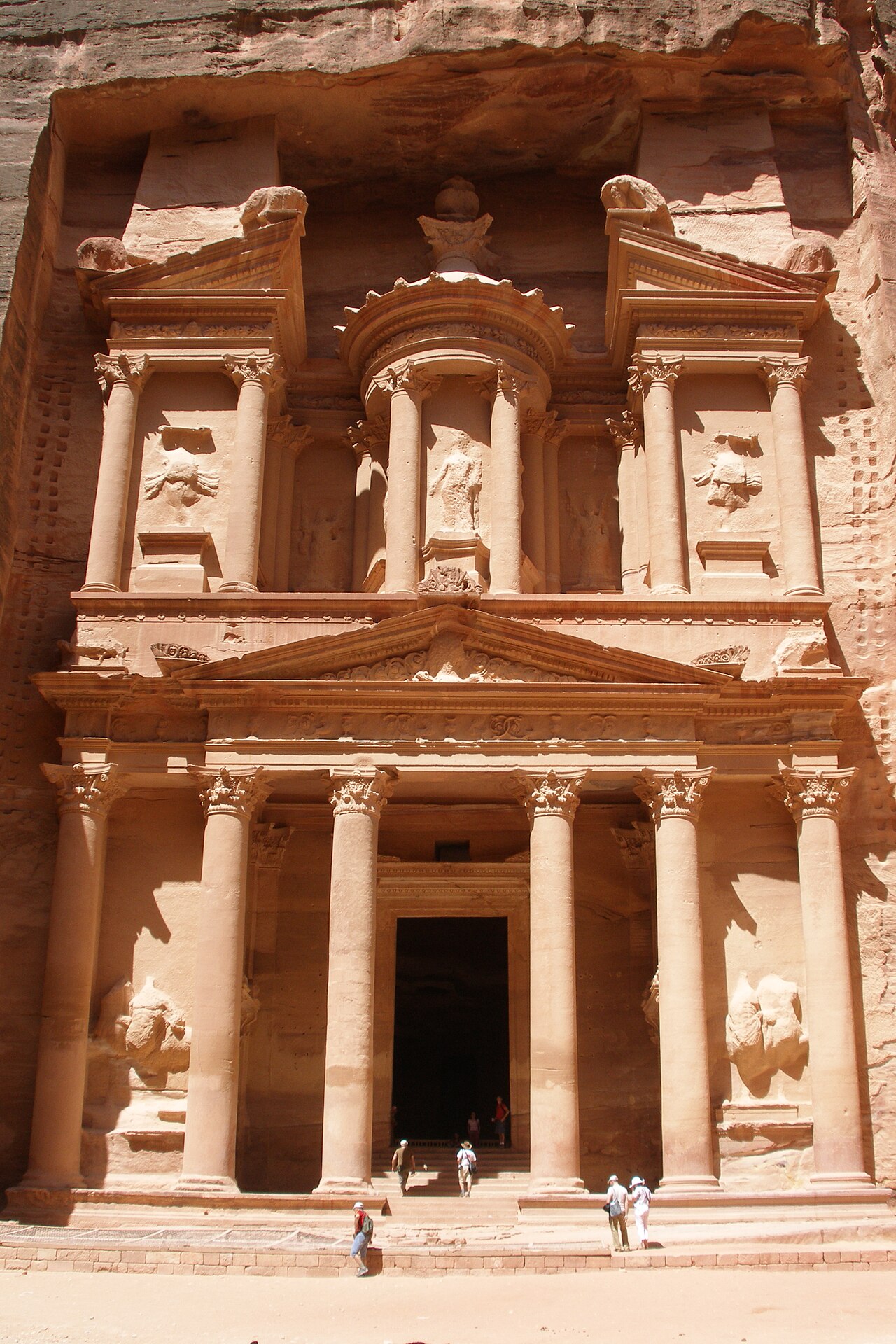
The moment you walk out of the Siq and see The Treasury is the whole reason to come to Jordan. After nearly a mile of narrow canyon walls pressing in from both sides — the rock sometimes barely three meters apart — a 40-meter-high carved facade suddenly appears in front of you. It's intact. It's rose-red. It doesn't look real. That moment alone justifies the flight.
Explore Petra
Discover Petra through photos that tell the story.
Find out how well you know Petra.
Petra was the capital of the Nabataean kingdom, an ancient Arab civilization that got extraordinarily wealthy by controlling the trade routes connecting Arabia, Egypt, and the Mediterranean. Founded as early as the 4th century BC, the city supported up to 30,000 people at its peak — built on the frankincense, myrrh, spice, and silk caravans that passed through its canyon entrance. The Nabataeans weren't just merchants. They were master builders who happened to pick one of the most improbable locations on earth to build a metropolis.
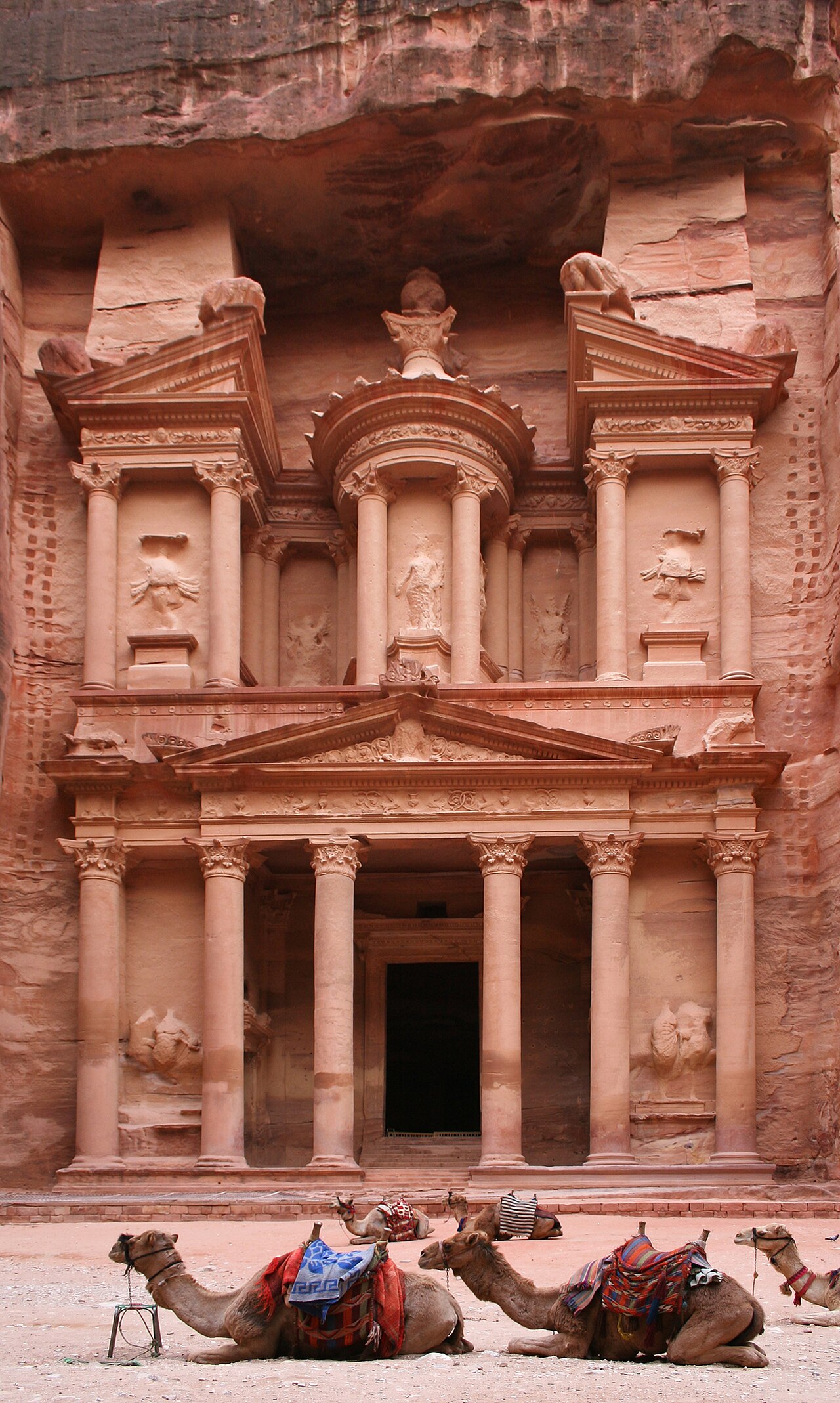
Al-Khazneh — 'The Treasury' — blends Nabataean, Hellenistic, and Egyptian architectural motifs in a facade that reflects a civilization sitting at the intersection of ancient cultures. It was almost certainly a royal tomb, likely for the Nabataean king Aretas IV. The bullet holes pocking the urn at the top are from Bedouin sharpshooters who believed a pharaoh had hidden treasure inside — which tells you something about how powerful the legend was. Archaeologists have found only empty chambers. The name stuck anyway.
Here's the honest caveat: The Treasury is what everyone comes for, and it earns it. But if you stop there, you've seen maybe 10% of Petra. Beyond Al-Khazneh there are hundreds of carved tombs, a 7,000-seat theater, a colonnaded Roman street, and the Monastery — Ad-Deir — a structure larger than The Treasury, sitting at the top of 800 carved steps. Most tourists don't make that climb. I'd argue it's the better monument. The Nabataeans also engineered an elaborate system of dams, cisterns, aqueducts, and ceramic pipelines that turned an arid canyon into a functioning city. That engineering story gets less attention than it deserves.
Petra's decline started when Rome annexed the Nabataean kingdom in 106 AD and gradually rerouted trade to sea lanes, cutting off the city's economic oxygen. A major earthquake in 363 AD accelerated the collapse, and the Western world had largely forgotten Petra existed until Swiss explorer Johann Ludwig Burckhardt disguised himself as an Arab pilgrim and visited in 1812. UNESCO designated it a World Heritage Site in 1985. Recent surveys using satellite imagery and ground-penetrating radar estimate that only 15% of Petra has been excavated. Whatever's still underground could completely rewrite what we know about the Nabataeans.