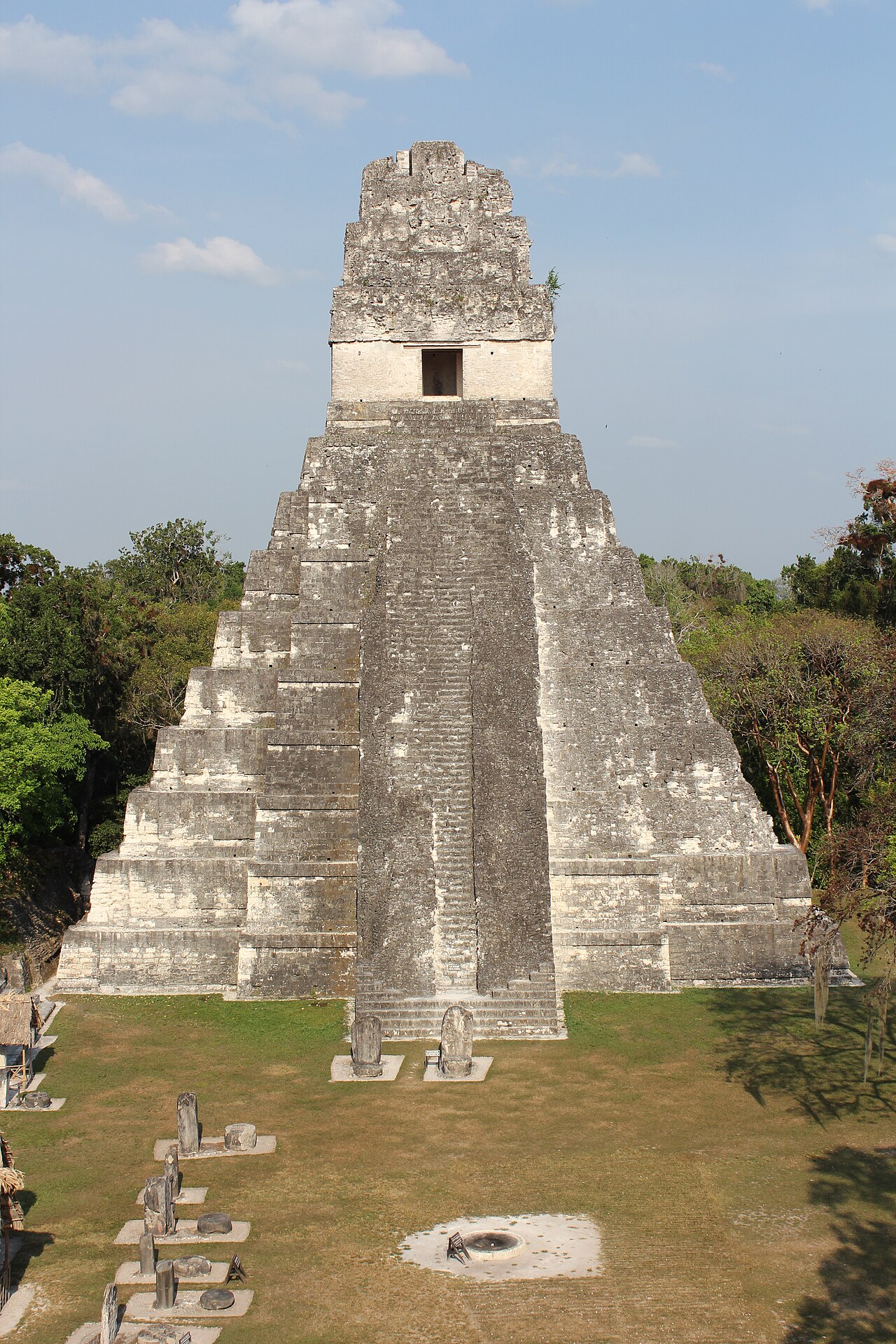
You hear Tikal before you see it. The howler monkeys start before dawn — closer to a roar than anything you'd expect from a monkey — and that sound is your real orientation to what this place is: a jungle that happens to contain a city. Tikal was one of the largest urban centers in the ancient Maya world, somewhere between 60,000 and 90,000 people at its Late Classic peak, around 600 to 800 CE. The first settlers arrived around 900 BCE, drawn to elevated ground, reliable water, and flint deposits. By the third century CE, a ruling dynasty was already entrenched. The Maya called it Yax Mutal, and that emblem glyph shows up on monuments hundreds of kilometers away — the kind of reach that tells you this wasn't a regional footnote.
Explore Tikal
Discover Tikal through photos that tell the story.
Find out how well you know Tikal.
Temple I is the one you've already seen in photographs, and it earns the attention. At 47 meters, it's not the tallest structure here, but it's the most purposeful: built around 732 CE as the tomb of Jasaw Chan K'awiil I, Tikal's greatest ruler. The burial chamber held jade ornaments, jaguar pelts, carved bone tubes depicting canoe voyages to the underworld, and nearly nine kilograms of jade and shell offerings. Across the Great Plaza, Temple II — the Temple of the Masks — honors his queen, Lady Kalajuun Une' Mo'. The two pyramids frame a plastered ceremonial plaza where thousands once gathered. Worth stopping for: the acoustics are genuinely strange. Clap at one end and the echo returns sharp and birdlike — researchers think it may have been engineered to mimic the quetzal. Whether that's right, it's the kind of detail that stops being trivia once you're standing there.
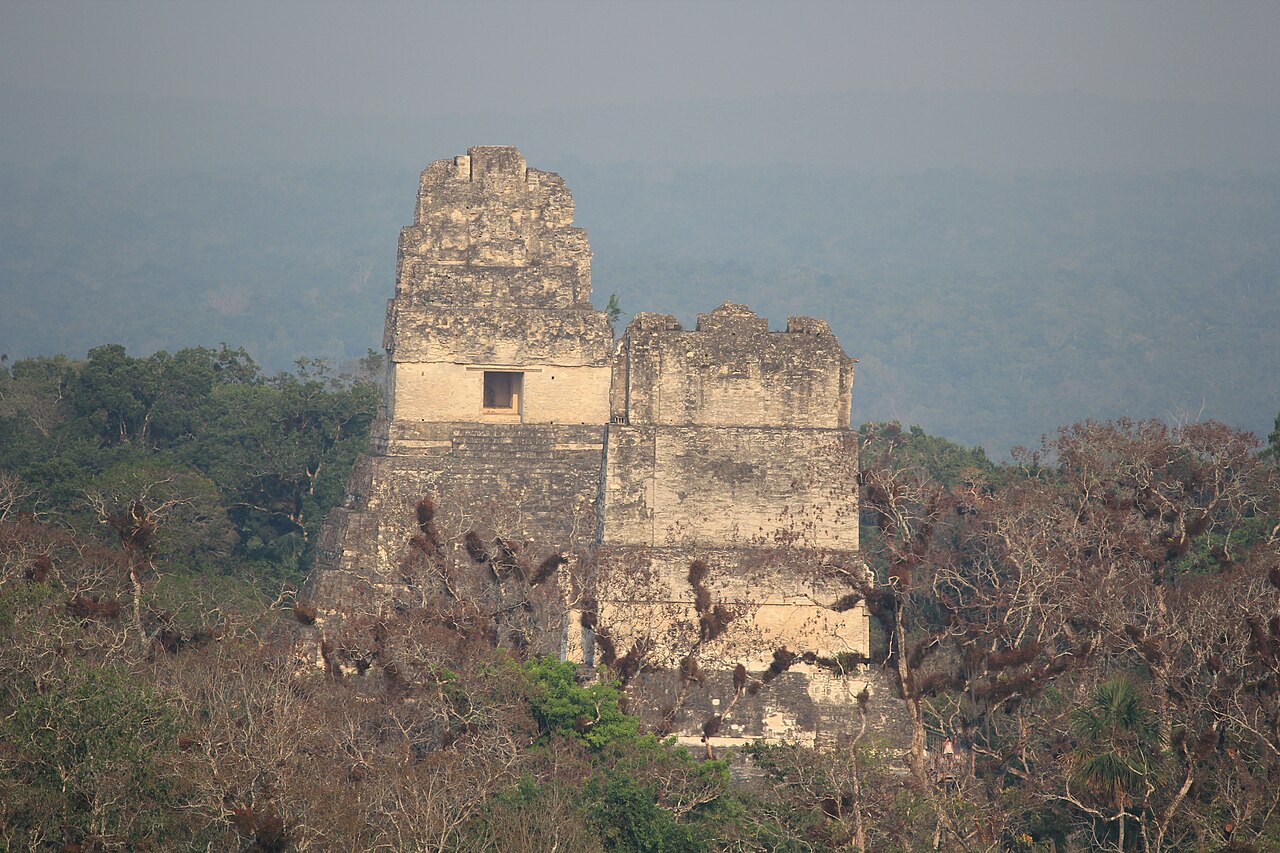
The Great Plaza draws most of the foot traffic, but the rest of the site is where the real depth is. Temple IV, at roughly 65 meters, is the tallest pre-Columbian structure in the Americas — built by Yik'in Chan K'awiil around 741 CE. The view from its rooftop platform is worth getting up before dawn for: mist on the canopy, roof combs breaking through the treeline. It's not overrated. The North Acropolis functioned as a royal necropolis for over a millennium — the University of Pennsylvania excavations in the 1960s found painted stucco masks, earlier temples sealed inside later ones, burial chambers going back to at least 200 BCE. Farther out, the Mundo Perdido complex holds an astronomical observatory whose stairways align precisely with solstice and equinox sunrise positions. The Maya weren't guessing at the sky — they'd been watching it for centuries.
Tikal's history isn't a straight line upward. In 378 CE, a warrior named Siyaj K'ahk' arrived and overthrew the reigning king in an event the stelae simply call 'the Entry.' He was probably acting for Teotihuacan, the great central Mexican power — and that influence is still readable in the architecture: talud-tablero platforms, Teotihuacan-style ceramics in elite tombs. Then in 562 CE, the rival city of Calakmul dealt Tikal a defeat serious enough that no new monuments were erected for 130 years. Scholars call it the Tikal Hiatus. Jasaw Chan K'awiil I reversed it, defeating Calakmul's king in 695 CE and commissioning the temples that define the site today. By the tenth century the population had essentially disappeared. Stela 11, carved in 869 CE, is the last dated monument. Within a generation or two, the jungle had reclaimed the plazas.
A few things here don't get enough attention. The stelae scattered across the site carry some of the longest hieroglyphic texts in the Maya world — wars, alliances, accessions, a thousand years of recorded history standing in the open air. The ballcourt between the Central Acropolis and Temple I is one of the oldest known in the lowlands, and the game wasn't sport: it carried cosmological weight, a physical enactment of the struggle between life and death, earth and sky. The reservoir system is legitimately impressive engineering — plastered tanks and channels that captured seasonal rainwater and sustained tens of thousands through dry months. At least one reservoir shows evidence of sand-based filtration. The Maya figured out basic water purification centuries before it showed up in Europe.
I'd book early entry if it's available. The crowd situation matters here, and the morning hours — before the tour buses arrive — are when you actually feel the scale of the place. Spider monkeys overhead, ocellated turkeys on the plaza stones, jungle noise in every direction. Don't shortchange yourself on time. Tikal takes most of a day. A half-day layover from Flores doesn't do it. Early entry costs more. Pay it.