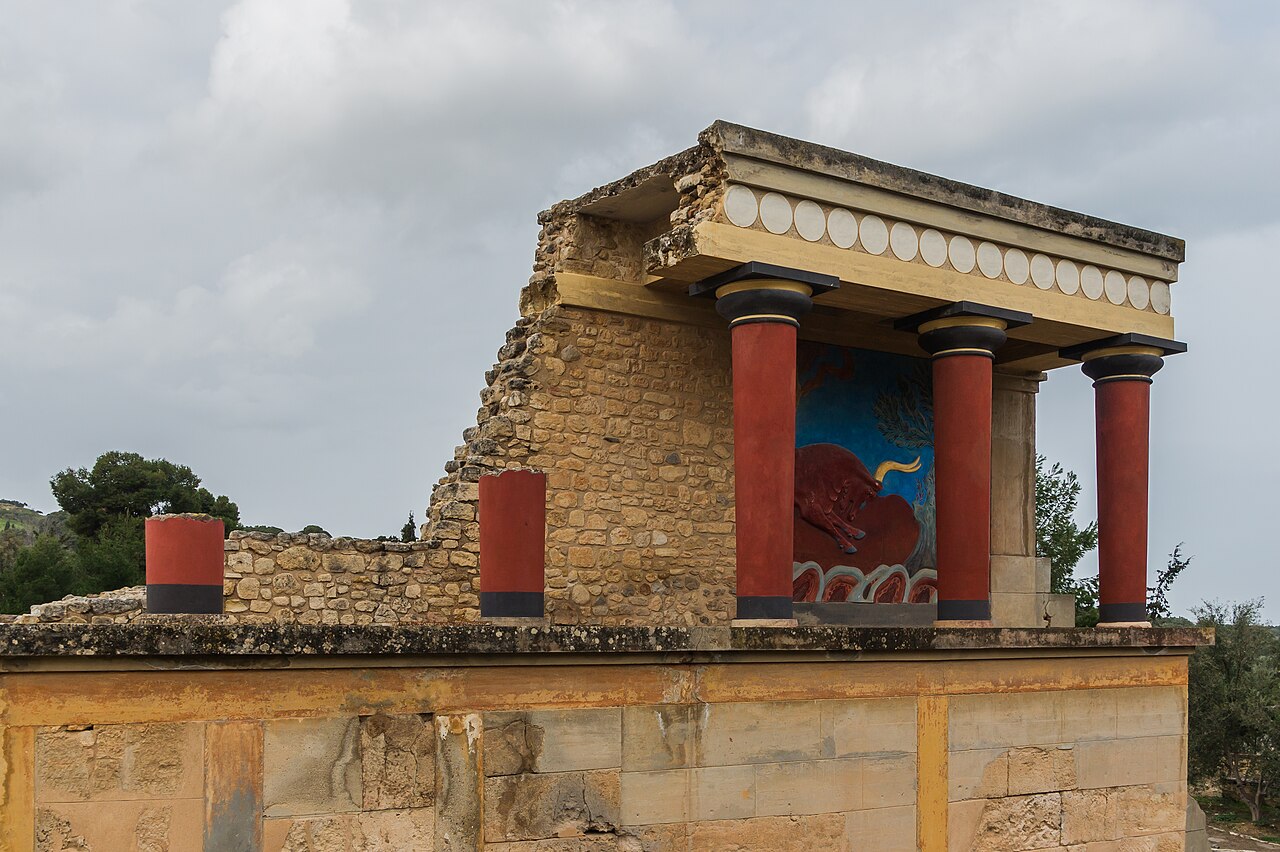
About half of what you see at Knossos isn't 3,500 years old. You can argue about whether that's legitimate archaeology or educated fiction. I'd argue it makes Knossos more interesting, not less.
Explore Knossos
Discover Knossos through photos that tell the story.
Find out how well you know Knossos.
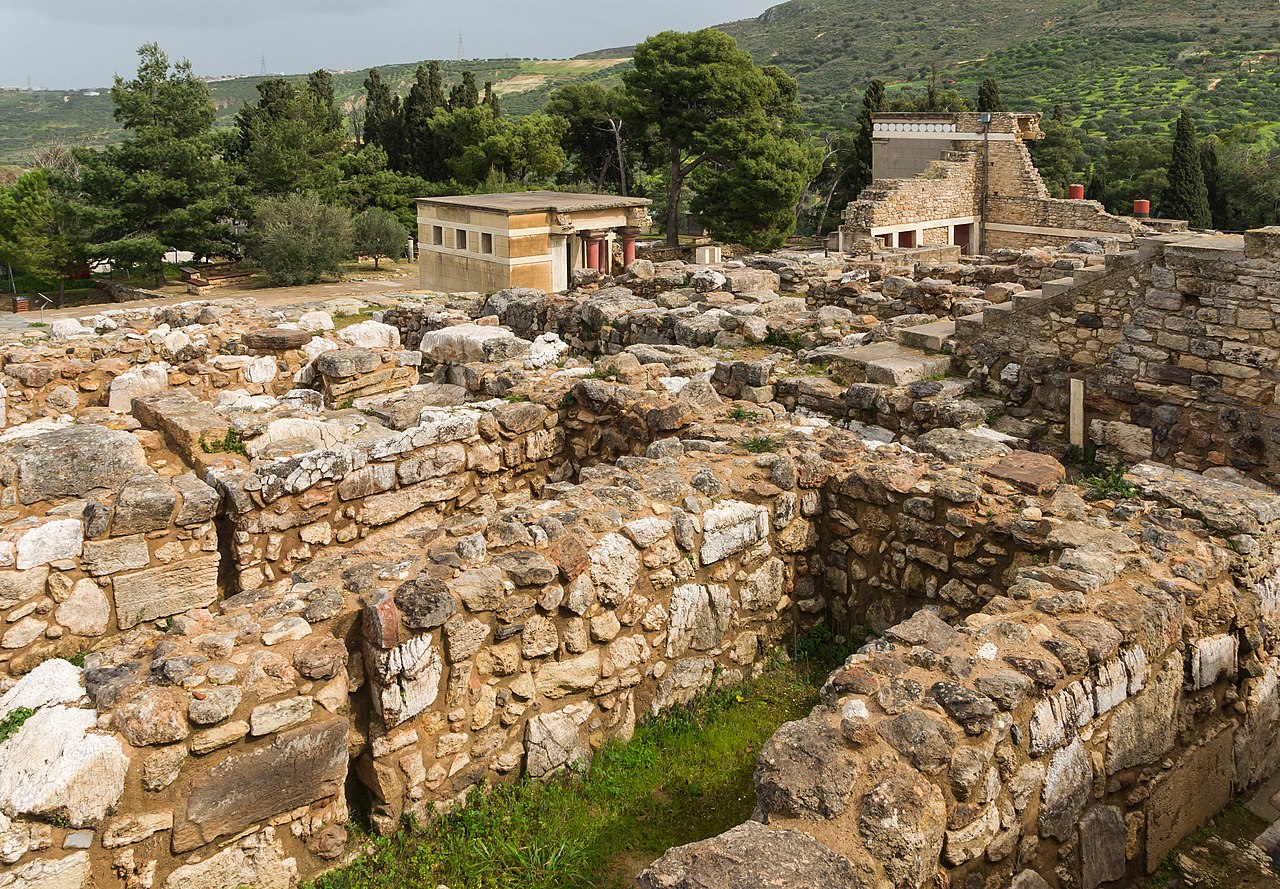
The palace complex covers 22,000 square meters and at its peak held more than 1,300 rooms around a central courtyard. The layout is genuinely disorienting — corridors twist and branch, stairways descend underground, rooms open into rooms with no apparent logic. This is almost certainly where the myth of the Labyrinth comes from, and once you're inside it, that origin story stops feeling like metaphor. The Minoans worshipped bulls with a devotion that bordered on obsession, and the palace frescoes show young athletes leaping over charging bulls in a ritual spectacle — which is either extraordinary courage or the ancient equivalent of a stunt show, depending on how you look at it.
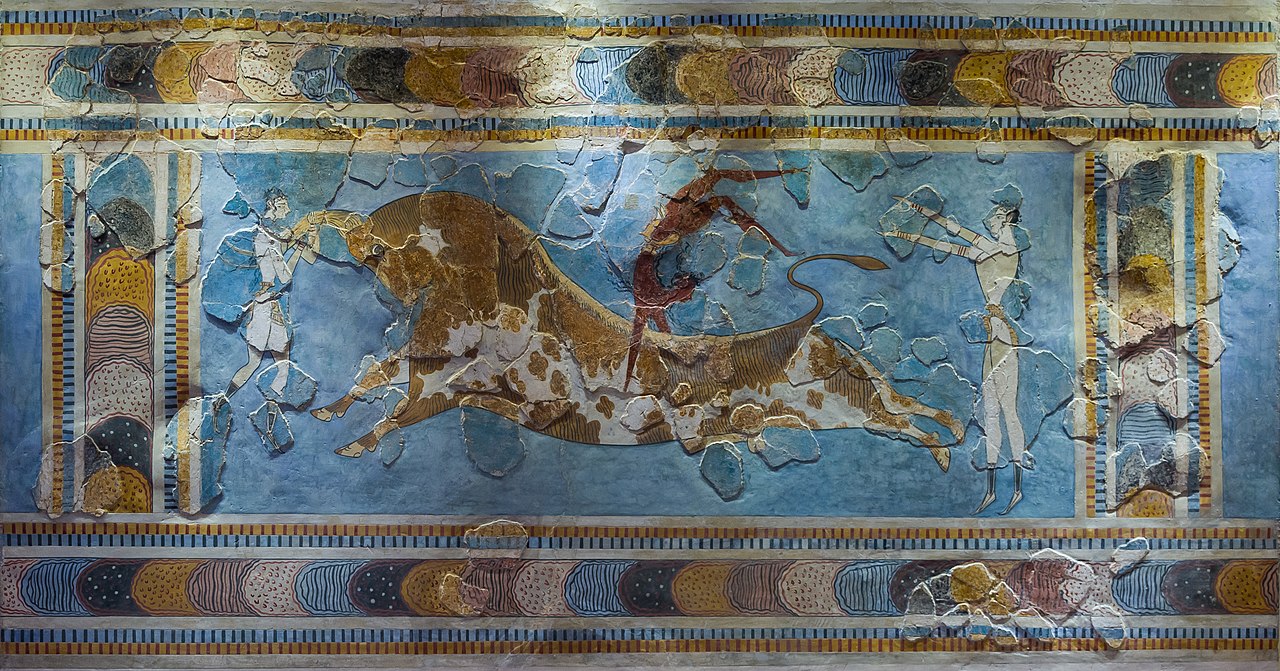
The frescoes are what stick with you. The Bull-Leaping Fresco shows a figure vaulting over a galloping bull with breathtaking precision. The Dolphin Fresco in the Queen's quarters fills an entire wall with blue sea creatures that look more like something from a contemporary art museum than Bronze Age Crete. These aren't stiff ceremonial images — they move. Vivid reds, blues, and ochres, still sharp after thirty-five centuries. The Minoans were the first European civilization to paint the natural world for the pleasure of seeing it, and honestly, they were very good at it.
Beyond the art, the engineering is quietly remarkable. The palace had a drainage system with clay pipes fitted with tapering joints to control water pressure — a principle Europe wouldn't rediscover for thousands of years. The Queen's quarters included what appears to be a flushing toilet connected to a sewage system. The Grand Staircase descends four stories lit by a system of light wells that channeled sunlight into the depths of the building. Storage magazines held clay jars taller than a person, stocked with olive oil, wine, and grain. Knossos wasn't just a palace — it was the logistical center of an entire island.
The Throne Room is the most memorable space. A carved gypsum seat — the oldest throne in Europe still in its original location — sits flanked by griffin frescoes against the north wall. A sunken ritual basin before it suggests whoever sat there went through a purification ceremony first. Who that person was — king, queen, high priestess — remains unknown, because the Minoan writing system, Linear A, has never been deciphered. What we know about Minoan society comes almost entirely from images, not words.
The collapse of Minoan civilization is one of archaeology's better mysteries. Around 1700 BC the original palace was destroyed, probably by earthquake, then rebuilt even larger. Then around 1450 BC, every Minoan palace on Crete was simultaneously destroyed — except Knossos, which lasted another fifty years before falling too. The massive eruption of Thera (modern Santorini) around 1628 BC probably triggered tsunamis and ash fallout that weakened the culture over generations. Mycenaean Greeks from the mainland may have moved into the vacuum. The Minoans themselves can't tell us — their records are still locked in an uncracked script.
Which brings us back to Evans. His reconstructions are controversial among archaeologists who argue he imposed his Edwardian imagination on a civilization we barely understand. That's a fair criticism. But the alternative — a flat field of foundation stones — would communicate almost nothing to a non-specialist visitor. The reconstructed columns give you a sense of scale that no site plan can match. I'd rather see a thoughtful interpretation and know it's an interpretation than stare at unmarked rubble. Go with that context in mind, and Knossos is one of the most compelling ruins in the Mediterranean.