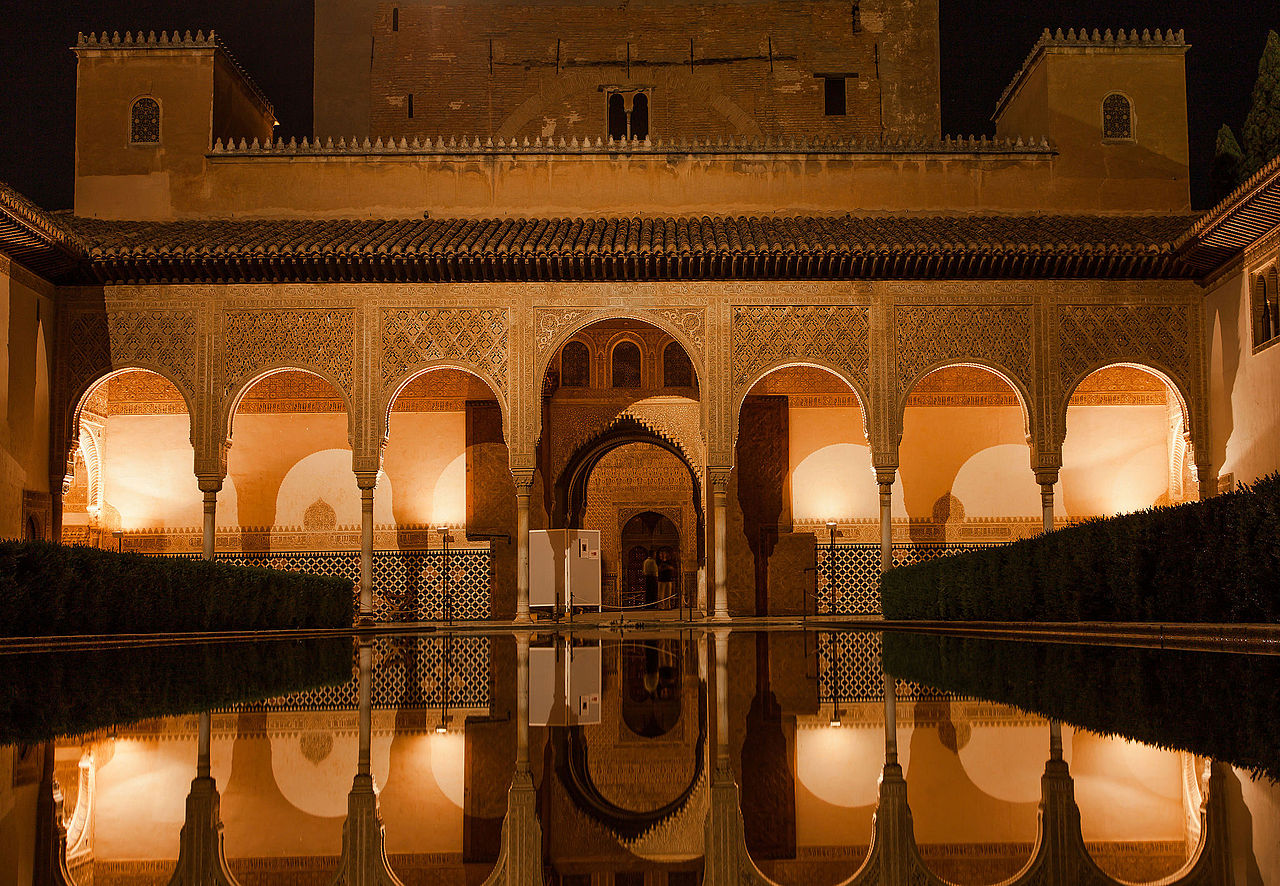
The Alhambra looks decorative from a distance. The closer you get, the more it becomes clear that every pattern is doing theological work. Every surface trembles with pattern: eight-pointed stars radiating outward into interlocking polygons, arabesques spiraling into infinity, muqarnas ceilings folding into honeycomb vaults that seem to dissolve into pure light. This was not decoration for its own sake. The repetition of perfect geometric form — endlessly generating, never resolving — was the closest a human hand could come to expressing the infinite nature of the divine. Spain's Moorish palaces are among the most philosophically ambitious structures ever built, and to visit them is to enter an argument about eternity.
Explore Moorish Palace Architecture
Discover Moorish Palace Architecture through photos that tell the story.
Find out how well you know Moorish Palace Architecture.
The story of Moorish architecture in Spain begins with the Umayyad conquest of 711 AD and the eight centuries of Islamic civilization that followed in Al-Andalus. At its height, Córdoba was the largest city in Western Europe, home to libraries, public baths, and a culture of extraordinary intellectual refinement. The Great Mosque of Córdoba — the Mezquita — captures that golden age in its forest of double arches, alternating red brick and cream stone striped like the inside of a shell. When the Reconquista absorbed the city in 1236, a cathedral was built directly into the mosque's heart, a jarring collision that paradoxically preserves the Islamic structure by making it untouchable. Visitors today move from the cathedral's baroque nave into the hypostyle hall with a sensation of stepping backward through centuries, the air suddenly cooler, the columns multiplying in every direction like reflections in facing mirrors.
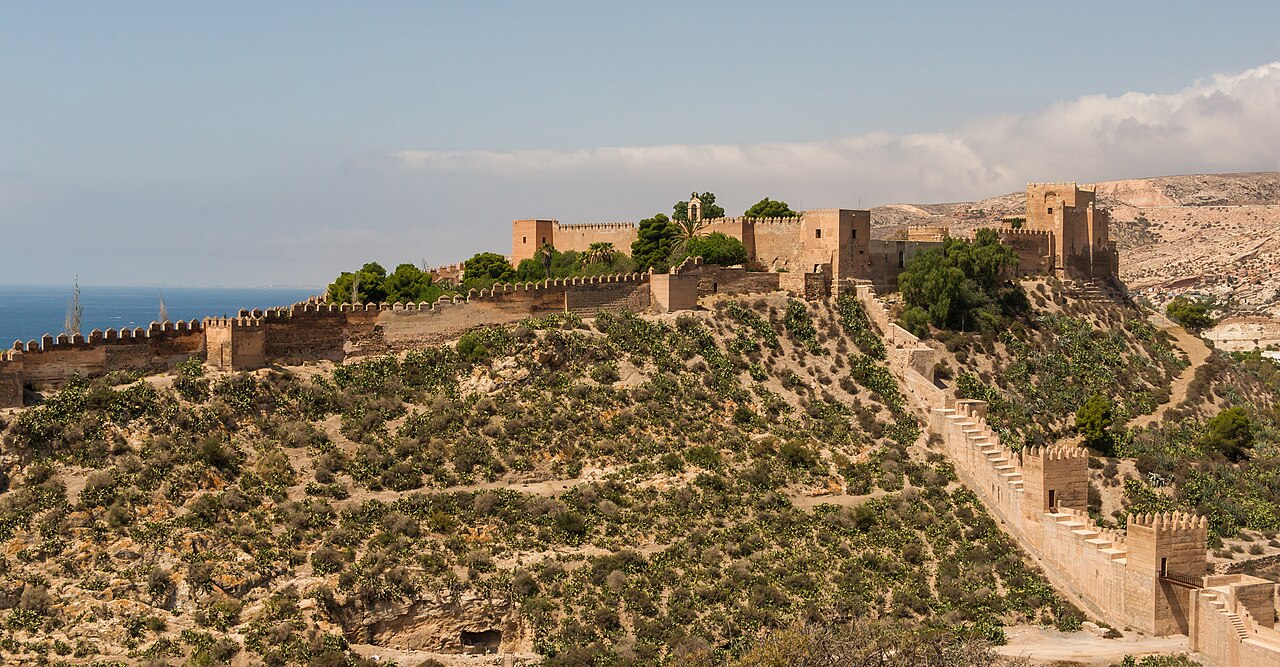
Seville's Alcázar offers a different lesson: the persistence of aesthetic desire across religious and political lines. When King Pedro I rebuilt the palace in the 14th century after the Reconquista had claimed the city, he did not import French Gothic craftsmen or Flemish stone carvers. He sent for Moorish artisans from Granada to build him something in the Mudejar style — Islamic architecture made for Christian kings. The result is a palace of staggering sensory richness, its walls clad in geometric tilework called azulejos in cobalt, ochre, and white, its upper registers dissolving into stucco lacework so fine it seems woven rather than carved. The Courtyard of the Maidens — a long reflecting pool flanked by slender arches — demonstrates the central Moorish principle that water is not amenity but architecture: its stillness doubles the arches above it, its movement catches light and scatters it across the walls, making the palace seem to breathe.
It is in Granada, however, that the synthesis of geometry, water, and light reaches its most complete expression. The Alhambra sits above the city on a red clay hill, its exterior walls pragmatically severe — military, almost dull. Inside the Nasrid Palaces, the world inverts entirely. The Court of the Lions centers on its famous fountain, twelve marble lions arranged in a circle that scholars believe encoded a solar calendar, water flowing from their mouths through channels that divide the courtyard into quadrants — the four rivers of Paradise described in the Quran. Surrounding this are halls in which every square centimeter of wall has been carved, painted, or tiled: bands of Quranic calligraphy run at eye level, geometric tessellations cover the lower walls, and above everything the muqarnas vaults hang like stalactites made of prayer. The Hall of the Abencerrajes has a ceiling of such mathematical complexity — sixteen-pointed stars generating a vortex of prismatic cells — that modern architects still struggle to fully reverse-engineer its construction.
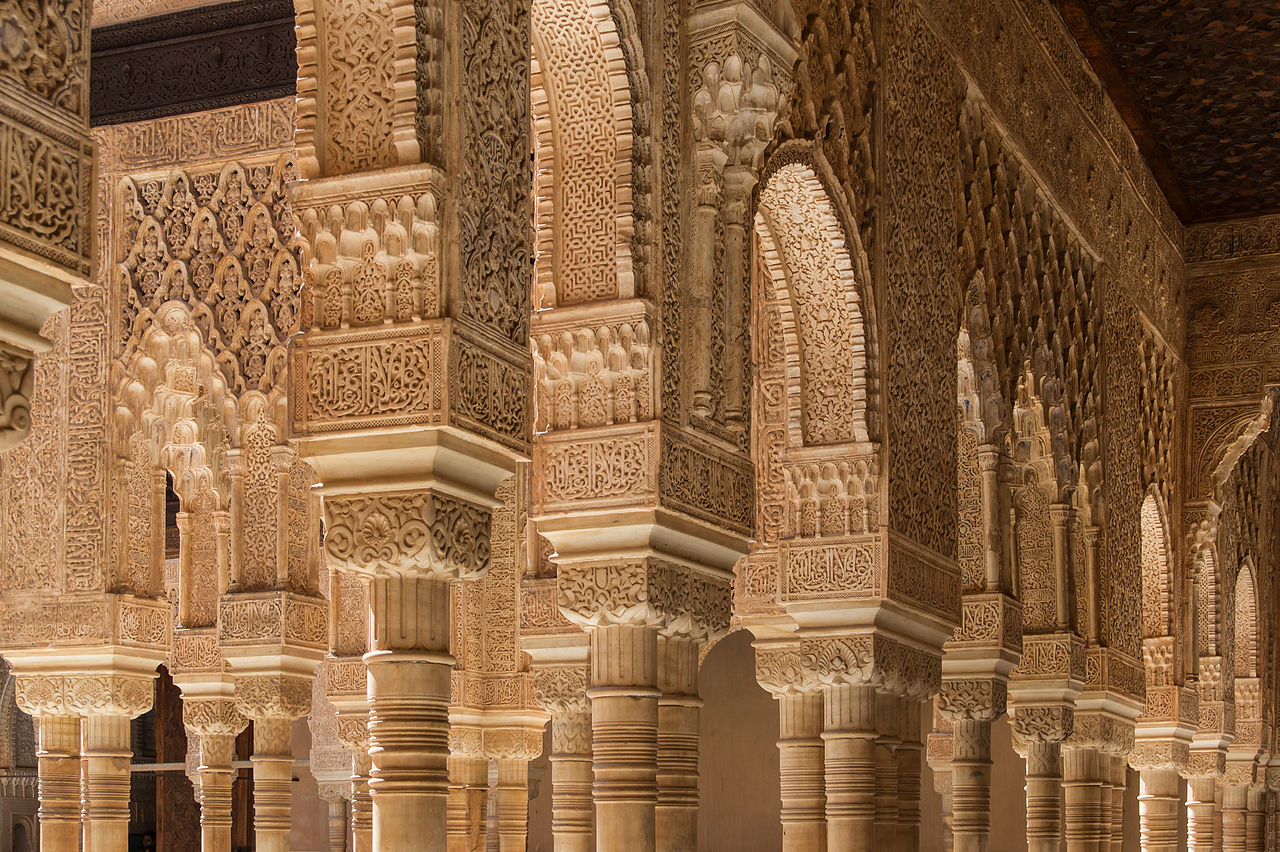
The Generalife gardens, the summer retreat above the Alhambra, reveal the outdoor dimension of this aesthetic. Irrigation channels run the length of arched garden corridors, jets of water arcing overhead in precise parabolas, the sound of moving water constant and deliberate. In a landscape of summer heat and drought, the Nasrids engineered abundance from scarcity, routing snowmelt from the Sierra Nevada through an elaborate hydraulic system to make their gardens run with the sound of rivers. This was power and piety braided together — the ruler who could conjure Paradise in a dry hillside demonstrated both technical mastery and divine favor.
Visiting these palaces today requires patience and planning; the Alhambra's timed entry tickets sell out weeks in advance, and the experience rewards slow movement and sustained attention. Come early, when the light is low and the tile catches the first oblique rays. Sit beside the reflecting pools long enough for the wind to drop and the surface to go still. The geometry is not meant to be consumed in a glance — it is meant to be inhabited, to work on you the way music works, accumulating meaning through repetition and variation. Spain's Moorish palaces are not ruins of a lost civilization. They are an ongoing argument, still fully legible, about what architecture is for.