
Rising from a granite island in the tidal flats of Normandy, France, Mont Saint-Michel is one of the most dramatically situated religious monuments in the world — a medieval abbey perched on a rocky islet that becomes an island twice daily at high tide, when the surrounding bay fills with some of the fastest-rising waters in Europe. The abbey's silhouette — layered rooftops, flying buttresses, and the gilded statue of Archangel Michael at its summit glinting against the sky — has been drawing pilgrims and warriors, tourists and artists for over thirteen centuries, making it an enduring symbol of France's spiritual and architectural heritage.
The religious history of the mount began in 708 AD when, according to tradition, Bishop Aubert of Avranches received a vision from Archangel Michael commanding him to build a sanctuary on the rocky mount. Aubert reportedly ignored the first two visions, and the angel finally burned a hole in his skull with a divine finger to make his point — the skull of Aubert, displayed at the church of Saint-Gervais in Avranches, appears to show a circular depression that local tradition identifies with the angel's touch. A small oratory was established, and Benedictine monks arrived in 966 AD when Duke Richard I of Normandy invited them to take over from secular canons.
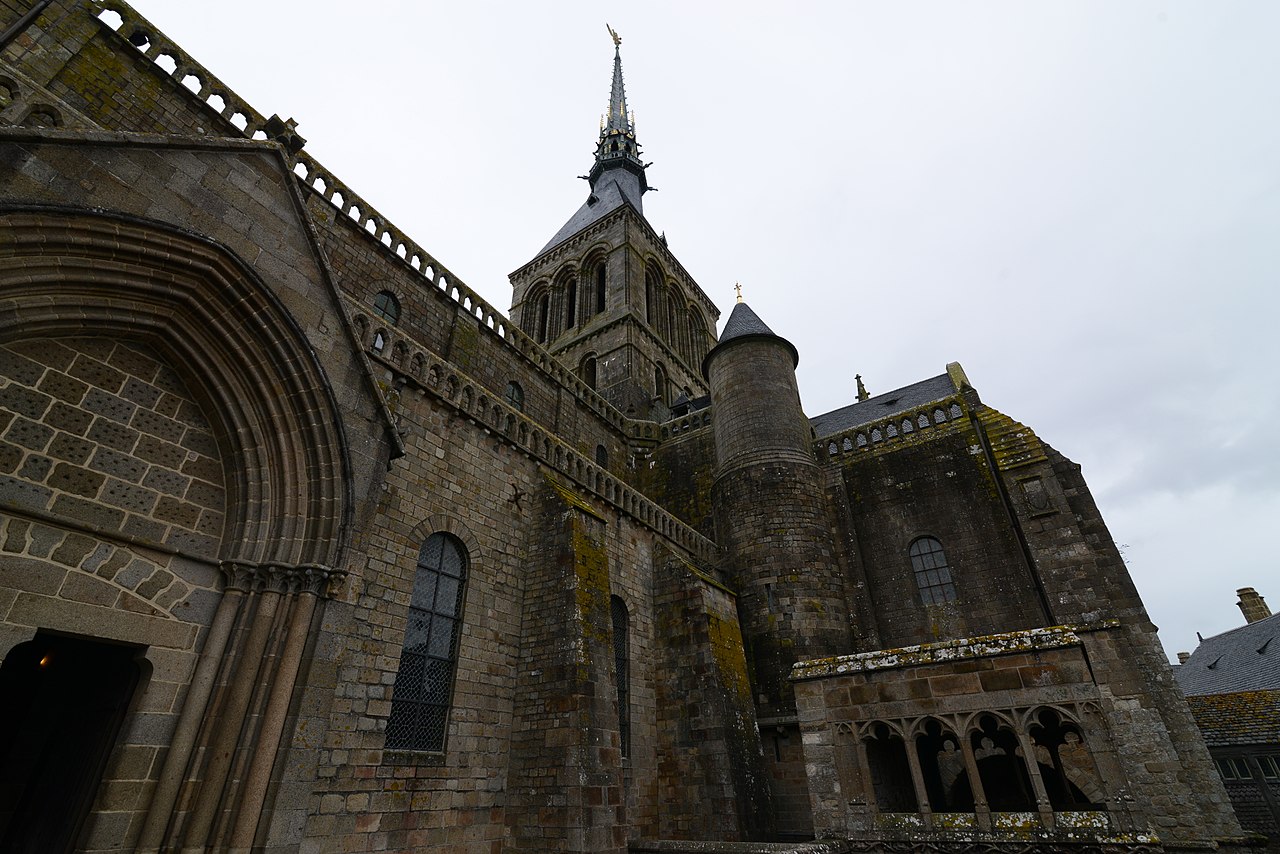
The great Gothic abbey that dominates the mount today was built primarily in the 13th century, though construction continued for 500 years as successive abbots added to and rebuilt the complex. The most ambitious section, La Merveille ('the Marvel'), consists of two three-story buildings on the north face of the rock completed between 1211 and 1228 AD, housing the cloister, refectory, and monks' dormitories in a masterpiece of early Gothic engineering. The cloister's arcades of delicate marble columns, set at a slight angle to each other to prevent visual monotony, represent one of the high points of Norman Gothic architecture.
Mont Saint-Michel's military history was as dramatic as its spiritual one. During the Hundred Years War (1337-1453), the mount was the only territory in northwestern France to resist English occupation, holding out for more than a century against sieges that the surrounding tides and the abbey's vertical defenses made nearly impractical. English forces were unable to capture it despite prolonged blockades. After the French Revolution, the abbey was converted into a prison — earning it the nickname 'the Mont Saint-Michel of the Seas' — until Victor Hugo's vocal protests, comparing the imprisonment of criminals in a cathedral to keeping a toad in a reliquary, helped restore its status as a historical monument.

Today Mont Saint-Michel and its bay are a UNESCO World Heritage Site (1979) drawing approximately three million visitors annually, making it the most visited site in France outside Paris. A major infrastructure project completed in 2014 removed the causeway that had been blocking tidal flow and replaced it with a bridge, restoring the island's natural tidal character and once again allowing the bay to flood fully at high tide. Monks and nuns of the Monastic Fraternities of Jerusalem have lived in the abbey since 2001, restoring its centuries-old tradition of active religious life.