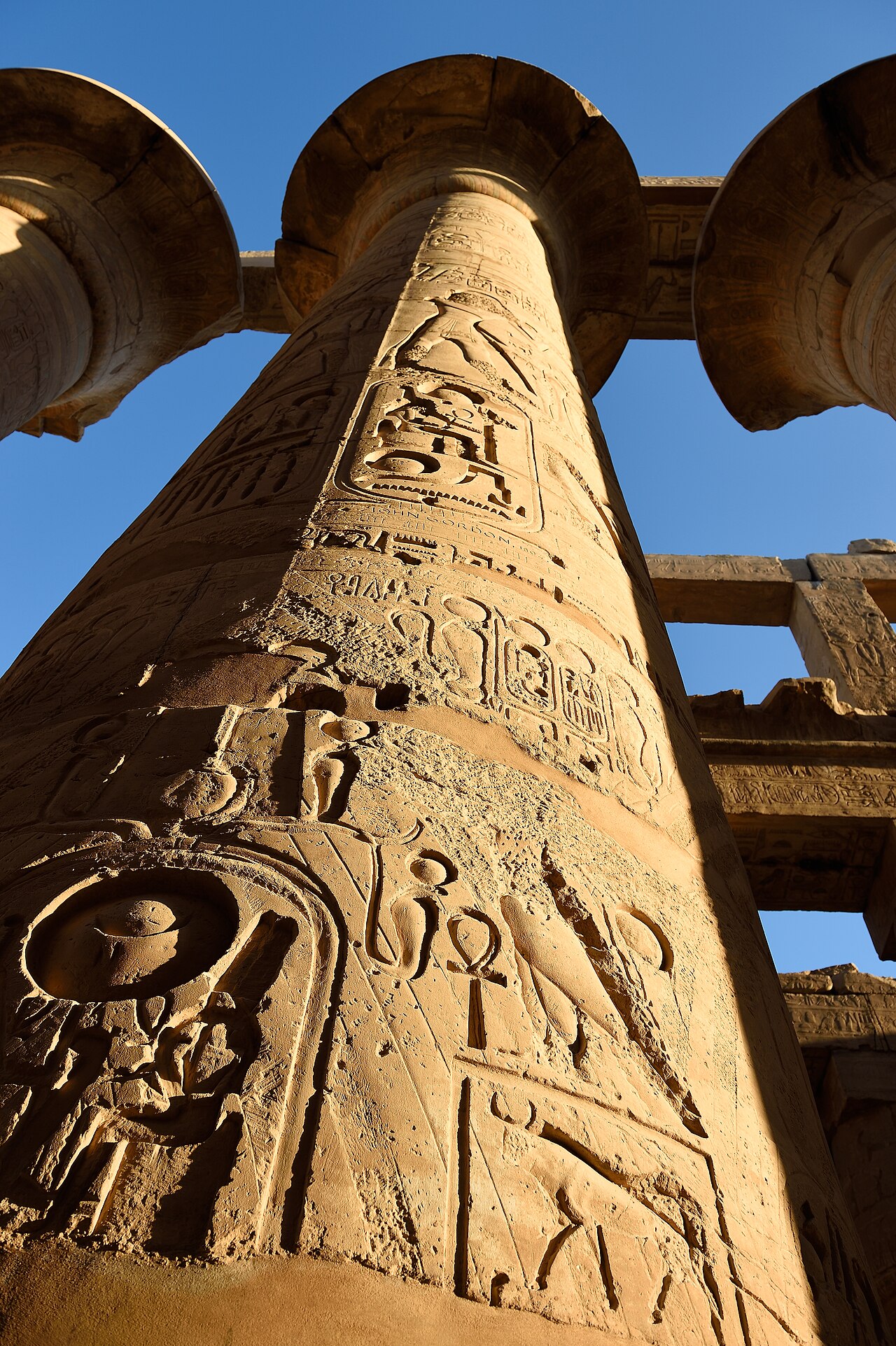
For the ancient Egyptians, the city they called Waset — the city we know as Luxor and the Greeks called Thebes — was the most sacred place in the world: the seat of the gods, home to the great temple complexes of Karnak and Luxor on the east bank, and site of the royal burial ground in the Valley of the Kings on the west. At its height during the New Kingdom period (1550-1070 BC), Thebes was probably the largest city in the world, its skyline dominated by the pylons and obelisks of temple complexes that were added to by every pharaoh seeking to demonstrate their piety and power. Homer praised it as 'hundred-gated Thebes,' and the ancient world recognized it as uniquely magnificent.
The Karnak temple complex, dedicated primarily to Amun-Ra, king of the gods, was not built by any single ruler but accumulated over approximately 2,000 years from around 2055 BC to 100 BC — making it the largest religious complex in human history and the work of perhaps 30 different pharaohs. Its most celebrated interior space is the Great Hypostyle Hall, built under Seti I and Ramesses II in the 13th century BC: 134 massive papyrus-capital columns arranged in 16 rows fill a space larger than a football field, their surfaces covered in painted religious texts and images that once glowed with vivid color in the dim interior. The hall was so large that the entire Cathedral of Notre-Dame could fit inside it.
Across the Nile on the west bank, the Valley of the Kings served as the royal necropolis for Egypt's pharaohs from the 18th through the 20th Dynasties (approximately 1539-1075 BC). Sixty-three tombs have been identified in the valley, cut deep into the limestone cliffs and decorated with elaborate paintings of the afterlife journey from the 'Book of the Dead,' the 'Amduat,' and other funerary texts. The tombs were robbed in antiquity — almost every one — but the relatively intact tomb of the boy pharaoh Tutankhamun, discovered by Howard Carter in 1922, gave the world an incomparable vision of New Kingdom royal burial wealth.
The mortuary temple of Hatshepsut at Deir el-Bahari, built around 1479 BC for the great female pharaoh who ruled Egypt as king for approximately 20 years, is one of the most elegant structures in the ancient world: three colonnaded terraces rising against the sheer cliffs of the Theban hills in a design that seamlessly integrates architecture and natural landscape. After her death, her successor Thutmose III ordered her images systematically defaced and her name chiseled from monuments — an act of historical revision that paradoxically helped preserve the temple, as workmen were less enthusiastic about destroying a monument they could not understand the reason for obliterating.
Modern Luxor, home to approximately half a million people, is surrounded by the greatest concentration of ancient monuments in the world. The Luxor Temple at the city center, connected to Karnak by a 3-kilometer sphinx-lined avenue recently reopened after decades of excavation, was the setting for the annual Opet festival celebrating the renewal of royal power. UNESCO designated the Theban Necropolis and related monuments as a World Heritage Site in 1979. Conservation challenges are enormous: flash floods, rising groundwater from irrigation, salt crystallization in painted tomb walls, and the breath of millions of visitors all threaten irreplaceable monuments that have survived 3,000 years of desert solitude.