No city in the ancient world punched above its weight like Athens. A rocky peninsula jutting into the Aegean, blessed with little farmland and no navigable rivers, it nevertheless produced the philosophical foundations of Western thought, the world's first democracy, and a clutch of buildings so precisely conceived that architects are still studying them 2,500 years later. Athens did not just participate in Western civilization — it invented most of the vocabulary.
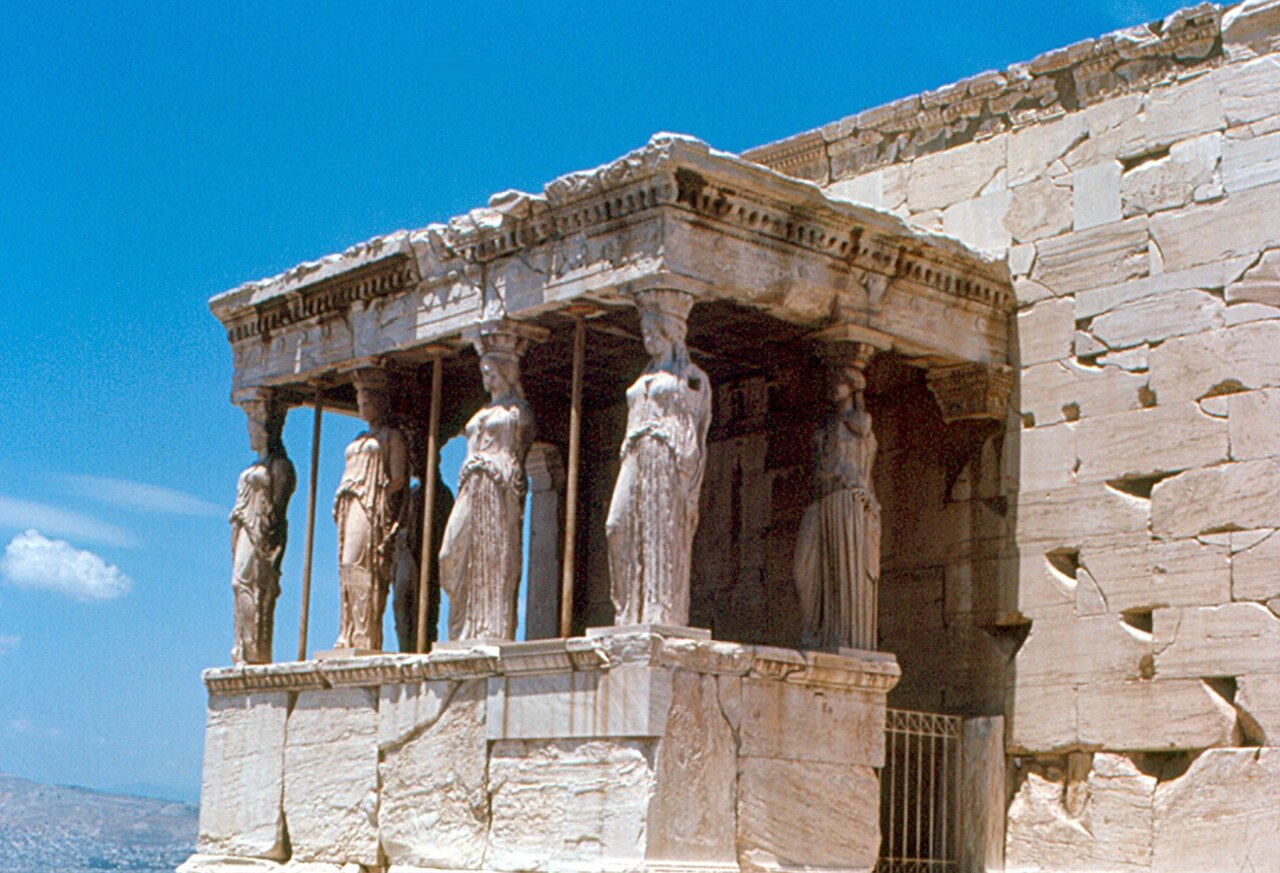
The city's golden age lasted barely fifty years — roughly 480 to 430 BC, between the Persian Wars and the outbreak of the Peloponnesian War. It was triggered by the unlikely Athenian victory at Marathon in 490 BC, when a force of perhaps 10,000 Athenians routed a Persian army twice its size, and cemented by the naval battle of Salamis in 480 BC, where the Athenian fleet destroyed the Persian armada in the narrow straits off the coast. With the Persian threat eliminated, Athens turned its energy and its tribute empire inward. Under the statesman Pericles, it embarked on the most ambitious building program in ancient history. The Parthenon, the Erechtheion, the Propylaea — all constructed within a single generation on a plateau of rock that had been a sacred site since the Bronze Age.
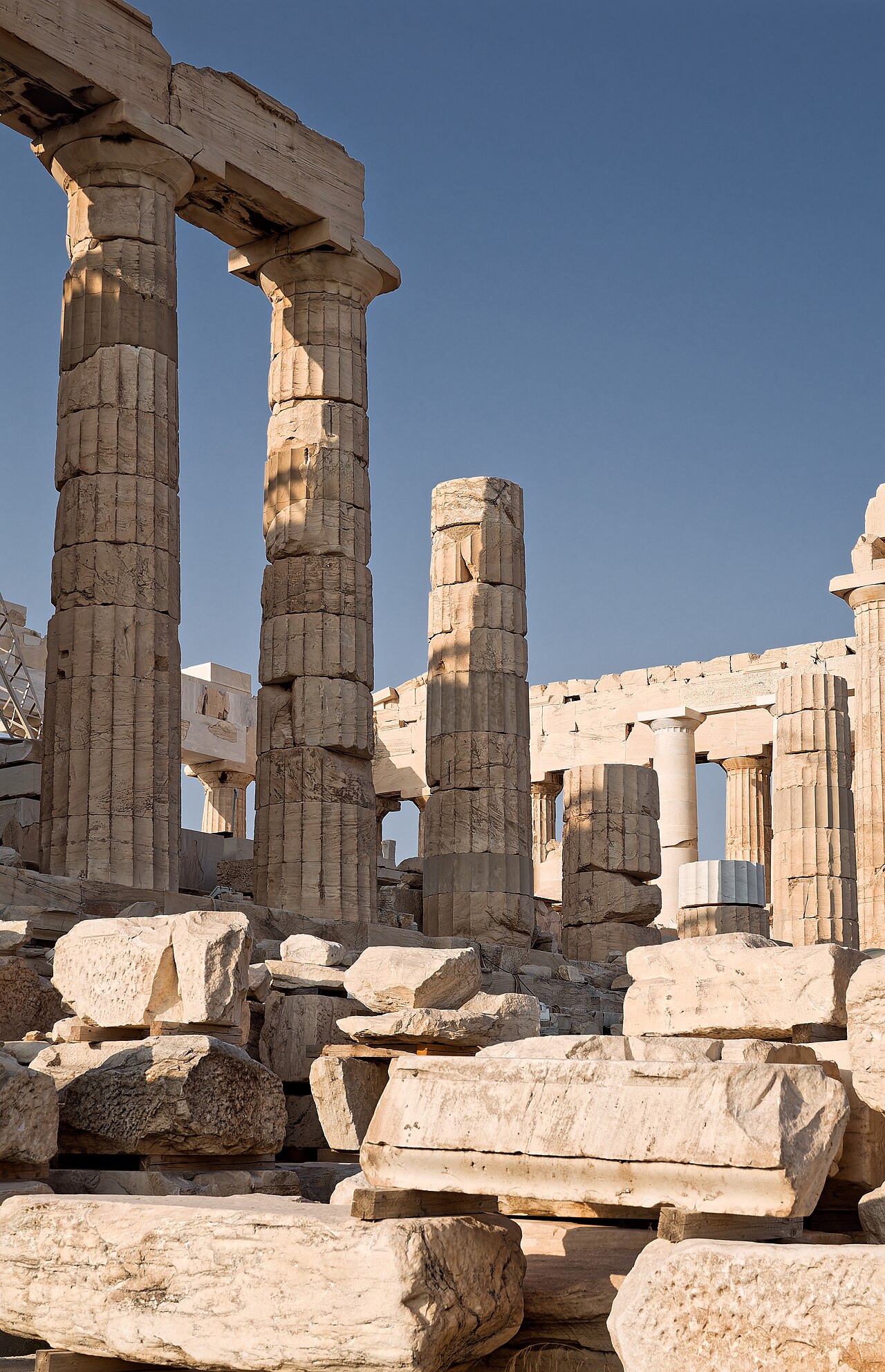
The Parthenon was completed in 432 BC after fifteen years of construction. It is built entirely of Pentelic marble quarried from a mountain ten miles away, and every horizontal surface curves imperceptibly upward to counteract the optical illusion that makes straight lines appear to sag. The columns taper and lean inward by fractions of an inch. There is not a single truly straight line in the building — it is a structure of calculated imperfections designed to look perfect. Inside stood a forty-foot-tall chryselephantine statue of Athena, covered in ivory and gold, by the sculptor Pheidias. The statue is long gone. The building has been a treasury, a Christian church, a mosque, and a gunpowder magazine. In 1687 a Venetian mortar round hit the stored powder and blew out the interior. The ruins that remain are still the most visited ancient monument in the world.
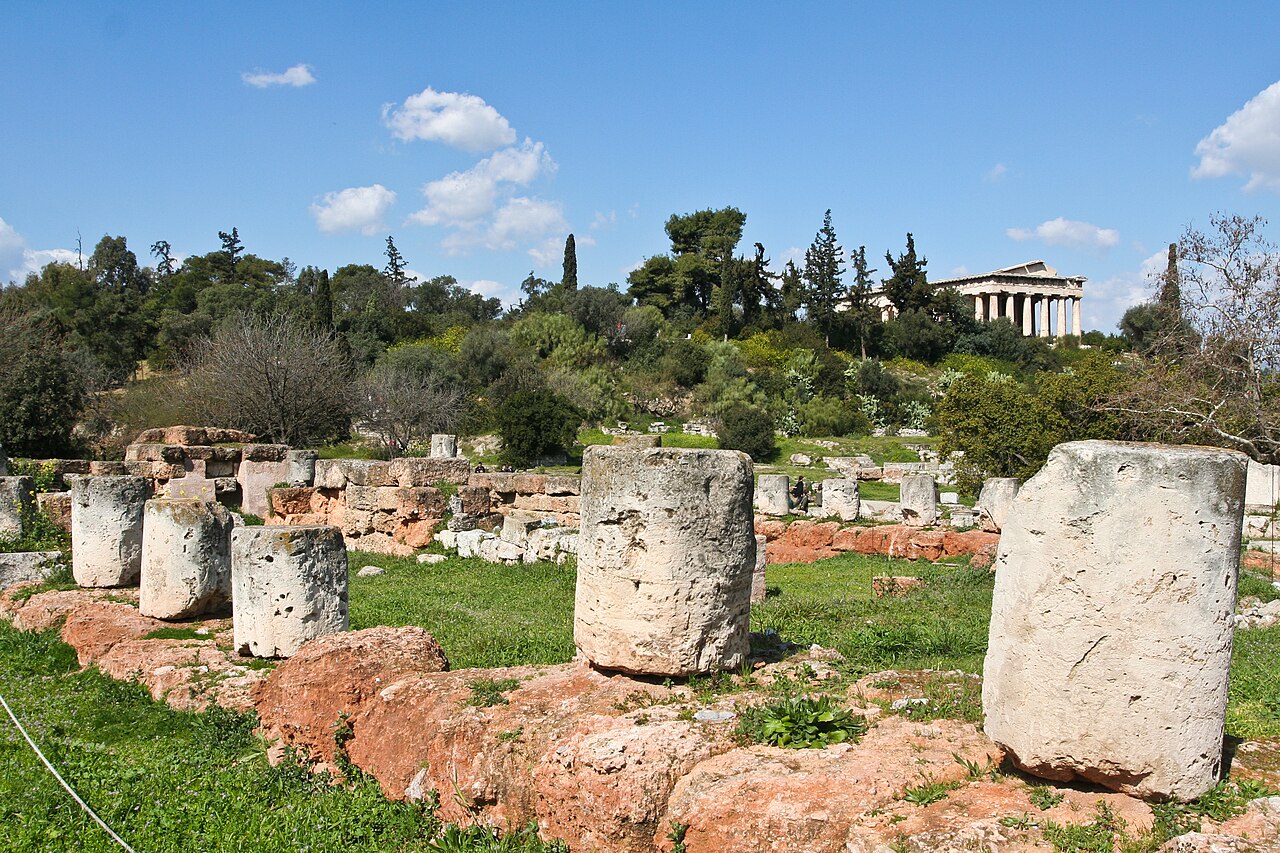
At the foot of the Acropolis lay the Agora — the beating heart of Athenian public life. This was where Socrates walked and questioned, where juries of hundreds of citizens voted on verdicts with bronze ballots, where the council that governed the city met in the round building called the Tholos. The philosopher who most shaped Western thought was also tried and executed here, in 399 BC, for impiety and corrupting the youth. His student Plato went on to found the Academy. Plato's student Aristotle tutored Alexander the Great. The chain of influence from a single hemlock-poisoned cup runs through virtually every subsequent tradition of Western philosophy.
Athens was conquered by Rome in 86 BC but conquered Rome intellectually almost immediately afterward. Roman aristocrats sent their sons to study in Athens; the Emperor Hadrian became so besotted with the city that he spent years there, completed the long-unfinished Temple of Olympian Zeus, and built a library, an arch, and an entire new quarter of the city in his own name. "This is Athens, the ancient city of Theseus," his arch declares on one side. "This is the city of Hadrian, not of Theseus," it says on the other.
Modern Athens is a city of four million people sprawling across the Attic plain, with a metro system that doubles as an archaeology museum — construction crews kept hitting ancient ruins, so the stations display what they found. The Acropolis Museum, opened in 2009, was built on a glass floor over an excavated ancient neighborhood, its top floor aligned precisely with the Parthenon on the hill above. Look up through the glass ceiling and the building you are studying looks back at you. Athens has been making that kind of architectural argument for a very long time.